
 NY Times Mini
 NY Times Crossword
 NY Times Midi
 NY Times Wordle
 NY Times Connections
 NY Times Connections Sports Edition
 NY Times Strands
 NY Times Spelling Bee
 NY Times Pips
 Word Salad
 Contexto
 Blossom
 Betweenle
 Conexo
 Bracket City
 Fluxis
 Stacks
 Atlantic Crossword
 LA Times Mini
 LA Times Crossword
 Word Hurdle
 Crosswordle
 NYT Crossplay Solver
 Anagram Solver
 Scrabble Word Finder
 Words With Friends Word Finder
 Atlantic Games
 LA Times
 Zorzzle
 Word of Fortune
 Browser Extension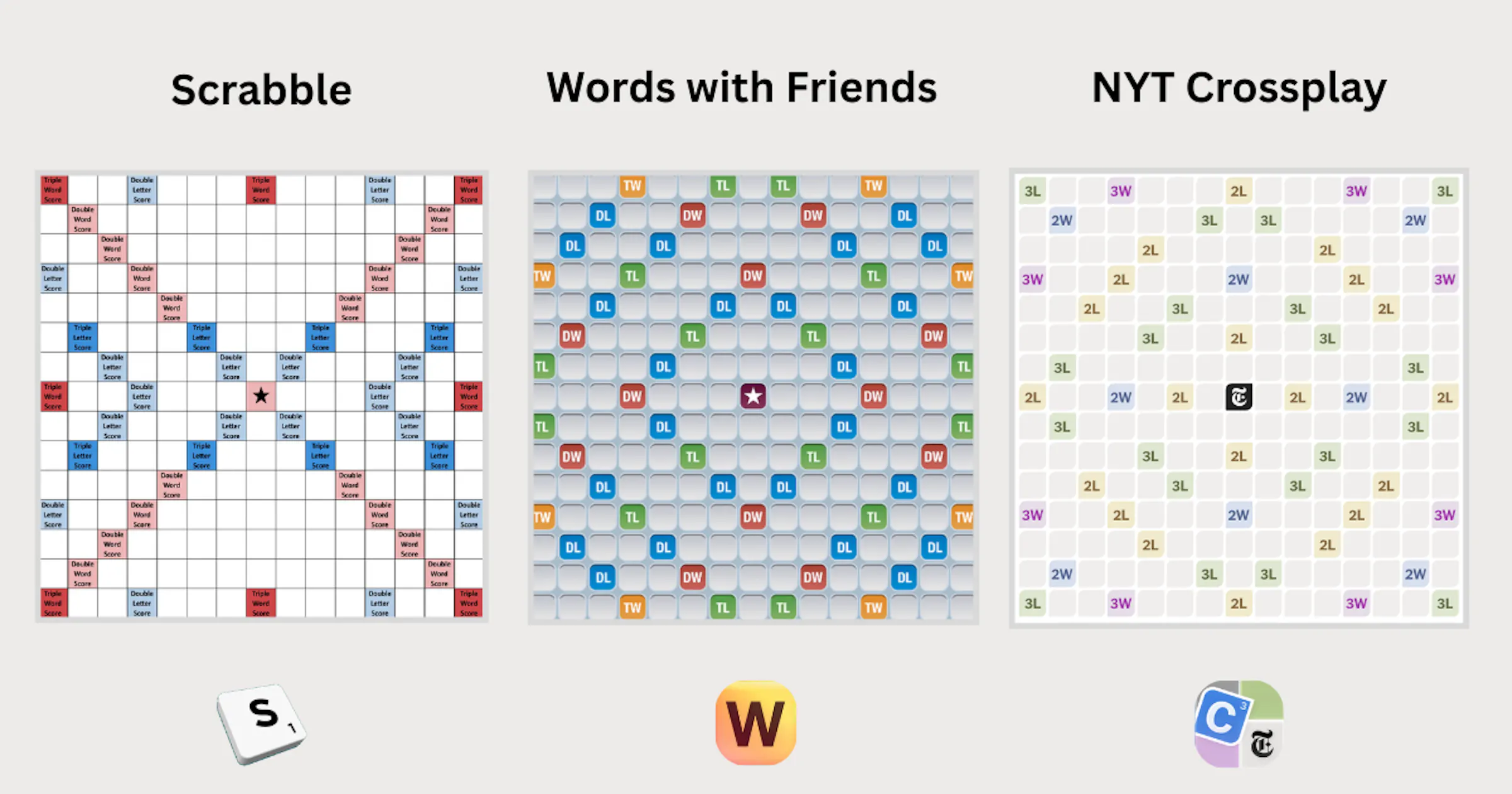
Three Eras of Word Play
Word games have a curious way of flourishing in the shadows of uncertainty. In 1933, amid the depths of the Great Depression, Alfred Mosher Butts, an unemployed architect, sought to combine skill and chance into a new pastime. His creation, first called Lexiko and later renamed Scrabble, married mathematics, language, and strategy, offering both distraction and mental exercise in dark times.
Did you know? Butts didn’t assign letter values at random — he analyzed the front page of The New York Times to calculate letter frequencies, creating the very first “algorithm” for balanced gameplay. Nearly a century later, that connection comes full circle: NYT Games now dominates the digital wordplay world, from Wordle to Crossplay, continuing the newspaper’s unexpected legacy in everyday word fun.
By the 1950s, it had become a cultural staple, a game that bridged living rooms and, eventually, competitive tournaments — the first era of word play: the classic, analog Scrabble era.
Decades later, during the 2009 economic downturn, the second era emerged. Words With Friends reimagined Scrabble for the iPhone, transforming leisurely wordplay into a social, asynchronous pastime. Millions embraced this digital, mobile-friendly version, often playing turns over days, connecting friends, family, and strangers across screens. It was a time when word games became social lifelines, a way to engage the mind while navigating uncertainty — the social mobile era.
Now, we find ourselves in a third era, emerging around 2020. A global pandemic accelerated a fascination with “bite-sized” puzzles: crosswords, Wordle, Connections, and now NYT Crossplay. Wordplay shifted from the occasional distraction to daily ritual, seamlessly woven into digital subscription ecosystems. This era blends mental stimulation with community, daily habit, and curated challenge — the NYT-dominated subscription era, a world where word games are no longer just pastimes, but integral parts of a player’s routine.
Across these three eras, one thread is clear: word games thrive when the world feels uncertain, offering focus, challenge, and the quiet satisfaction of mastery. And as NYT Crossplay stakes its claim in the digital multiplayer landscape, a question emerges: can it challenge Words With Friends and define this new era?
The Rise and Plateau of Words With Friends
Launched in 2009 by brothers Paul and David Bettner (Newtoy Inc.), Words With Friends was essentially Scrabble optimized for the iPhone 3GS. Its key innovation was asynchronous play, allowing players to take turns over days rather than sitting together. While its layout and scoring mirrored Scrabble closely, slight changes to bonus squares and letter values let it avoid legal challenges.

Between 2010 and 2012, WWF became a cultural phenomenon. Millions played daily, often via Facebook, and the game reached 20–22 million monthly active users. In 2010, social gaming giant Zynga acquired Newtoy for roughly $53 million. By 2011, it was the top-grossing App Store game, and in 2012 it even crossed into the physical world through a partnership with Hasbro. Anecdotes, like Alec Baldwin’s infamous airline incident in 2011, highlighted its mainstream popularity.
After 2012, WWF’s growth plateaued. Feature creep, ads, and flashy power-ups alienated some purists. Chat and bot-related scams further affected engagement. Despite this, WWF remained one of the most popular word games, with around 13 million monthly active users in 2017, a fraction of its peak but still significant.
Why NYT Is Entering Now
NYT Games’ journey from a single wartime crossword in 1942 to a digital wordplay powerhouse shows a long-term strategy finally hitting its stride. Under Will Shortz’s editorship from 1993, and boosted by the 2006 Wordplay documentary, the Crossword became a cultural fixture, later expanded through apps like The Mini in 2014. By 2020, subscriptions surged past 850,000, prompting a rebrand to NYT Games and the hiring of industry veterans Jonathan Knight (ex-Sims, FarmVille) and Zoe Bell (Zynga), signaling a serious growth push. The acquisition of Wordle in 2022, followed by Connections, cemented the NYT’s dominance in bite-sized, highly shareable puzzles. By 2023, users were spending more time in the Games app than in News, and in 2025, NYT Games puzzles were played 11.1 billion times, led by Wordle (5.3B plays), Connections (3.3B), and Strands (1.3B).
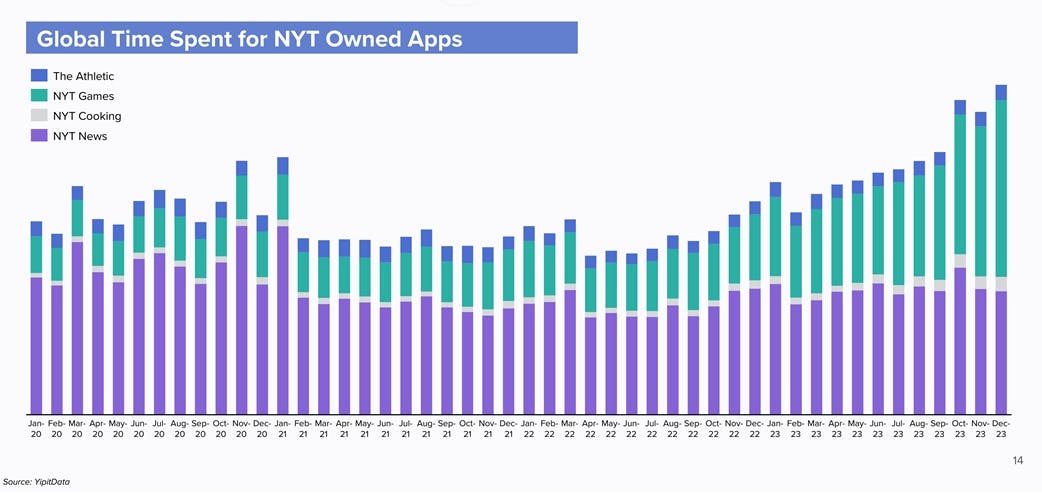
Rather than relying on ads like WWF, NYT leverages a subscription-driven “Bundle” strategy: as of February 2026, 6.5 million subscribers pay specifically for Games, Cooking, and The Athletic alongside News. Recent paywall shifts for popular games like the Mini Crossword and Letter Boxed are nudging casual players toward subscriptions, showing that NYT can monetize engagement sustainably. With this scale, strategy, and ecosystem, the company is now poised to enter the multiplayer arena with Crossplay, targeting the audience WWF once owned.
Where the Games Truly Differ
At first glance, Scrabble, Words With Friends, and NYT Crossplay appear nearly identical: a 15×15 grid, familiar tiles, and the same core objective of building high-scoring words. Yet each game introduces deliberate variations. Some changes were originally driven by legal necessity while others reflect shifting design goals to better meet the goals of each producer.
Board Design
Although all three games share the same grid size, their bonus-square geometry signals different design philosophies.
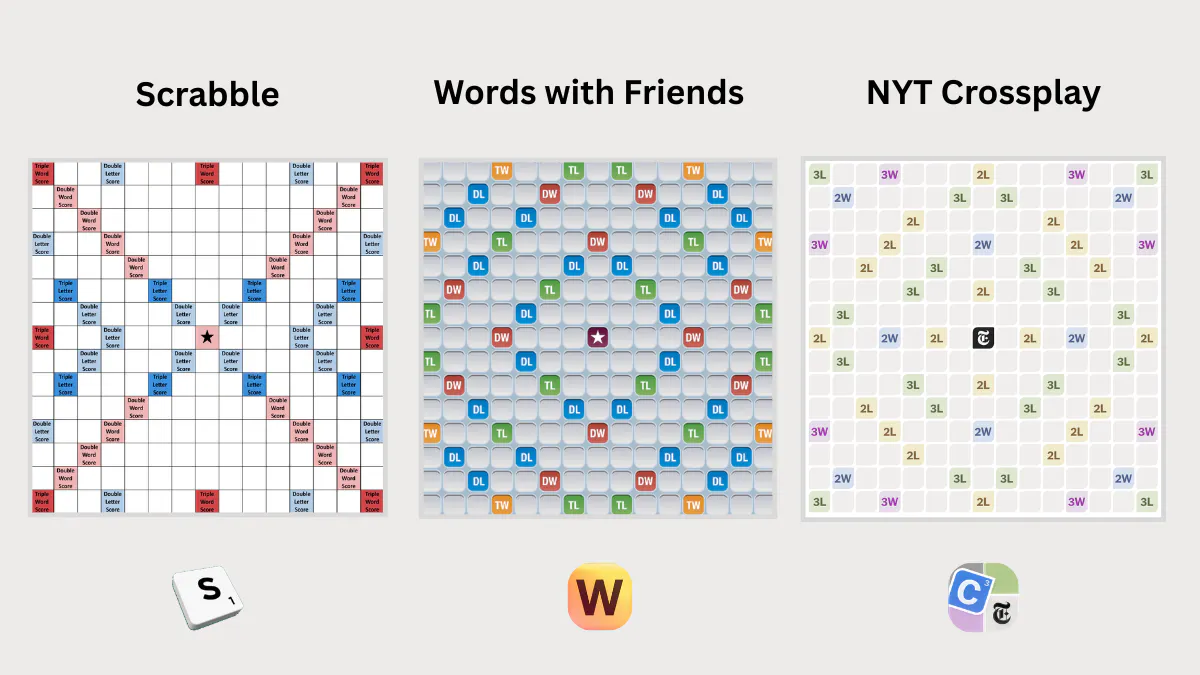
Scrabble’s layout forms a bold diagonal X stretching from corner to corner, concentrating high-value opportunities toward the center and edges in a symmetrical, tournament-tested structure.
Words With Friends and NYT Crossplay instead use nested diamond patterns, redistributing premium squares across the board and enabling occasional combinations of triple-word and triple-letter bonuses in a single move along the margins, a scoring dynamic impossible in classic Scrabble.
The total number and distribution of premium squares further distinguish the games:
- Scrabble: 50 bonus squares
- Words With Friends: 60 bonus squares
- NYT Crossplay: 56 bonus squares
All three retain eight triple-word squares positioned on the margins, but only Scrabble places them in the corners. WWF and Crossplay shift these inward along the edges, sharing the same general distribution.
Crossplay also stands apart in balance: it features the fewest double-word squares and an equal number of triple-letter and double-letter squares, unlike Scrabble and WWF, both of which emphasize double-letter bonuses more heavily than triple-letter ones.
| Bonus Square | Scrabble | WWF | NYT Crossplay |
|---|---|---|---|
| Triple Word | 8 | 8 | 8 |
| Double Word | 16 | 12 | 8 |
| Triple Letter | 8 | 16 | 20 |
| Double Letter | 18 | 24 | 20 |
| Total | 50 | 60 | 56 |
NYT Crossplay also introduces a subtle visual layer through color. Its bonus squares mirror the hierarchy familiar from Connections: purple marks triple-word scores (the hardest, highest-value tier), blue signals double-word bonuses, green represents triple-letter squares, and yellow denotes the smallest bonus, double-letter. This palette does more than decorate the board — it links Crossplay to the wider NYT Games ecosystem, using color to communicate difficulty, value, and progression in a way longtime puzzle players instinctively recognize.
Tiles
Tile systems reveal another layer of divergence.
- Scrabble: 100 tiles
- Words With Friends: 104 tiles
- NYT Crossplay: 100 tiles (matching Scrabble)
In scoring:
- Scrabble assigns 10 points only to Q and Z.
- WWF and Crossplay elevate J to 10 points as well, increasing the value of mid-frequency consonants.
- Crossplay further differentiates itself by assigning higher values to V and K than the other two games.
- It also includes three blank tiles, compared with the traditional two in Scrabble and WWF.
| Tile | Scrabble # of Tiles | Scrabble Point Value | WWF # of Tiles | WWF Point Value | NYT Crossplay # of Tiles | NYT Crossplay Point Value |
|---|---|---|---|---|---|---|
| Blank | 2 | 0 | 2 | 0 | 3 | 0 |
| A | 9 | 1 | 9 | 1 | 9 | 1 |
| B | 2 | 3 | 2 | 4 | 2 | 4 |
| C | 2 | 3 | 2 | 4 | 2 | 3 |
| D | 4 | 2 | 5 | 2 | 4 | 2 |
| E | 12 | 1 | 13 | 1 | 12 | 1 |
| F | 2 | 4 | 2 | 4 | 2 | 4 |
| G | 3 | 2 | 3 | 3 | 3 | 4 |
| H | 2 | 4 | 4 | 3 | 3 | 3 |
| I | 9 | 1 | 8 | 1 | 8 | 1 |
| J | 1 | 8 | 1 | 10 | 1 | 10 |
| K | 1 | 5 | 1 | 5 | 1 | 6 |
| L | 4 | 1 | 4 | 2 | 4 | 2 |
| M | 2 | 3 | 2 | 4 | 2 | 3 |
| N | 6 | 1 | 5 | 2 | 5 | 1 |
| O | 8 | 1 | 8 | 1 | 8 | 1 |
| P | 2 | 3 | 2 | 4 | 2 | 3 |
| Q | 1 | 10 | 1 | 10 | 1 | 10 |
| R | 6 | 1 | 6 | 1 | 6 | 1 |
| S | 4 | 1 | 5 | 1 | 5 | 1 |
| T | 6 | 1 | 7 | 1 | 6 | 1 |
| U | 4 | 1 | 4 | 2 | 3 | 2 |
| V | 2 | 4 | 2 | 5 | 2 | 6 |
| W | 2 | 4 | 2 | 4 | 2 | 5 |
| X | 1 | 8 | 1 | 8 | 1 | 8 |
| Y | 2 | 4 | 2 | 3 | 2 | 4 |
| Z | 1 | 10 | 1 | 10 | 1 | 10 |
| Total | 100 | 104 | 100 |
Dictionary (Word List)
Scrabble uses three official dictionaries: Collins Scrabble Words (CSW) for international tournaments with over 279,000 entries, the Official Scrabble Players Dictionary (OSPD) for casual North American play with about 178,000 words, and the NASPA Word List (NWL), the U.S. and Canada tournament standard with roughly 196,000 words.
Words With Friends relies on the long-standing ENABLE word list, supplemented with selected slang and abbreviations to suit casual digital play.
NYT Crossplay aligns directly with competitive Scrabble by using the NASPA Word List, signaling an intentional bridge between tournament legitimacy and modern digital design.
Gameplay Rules
Crossplay’s most meaningful innovations emerge in gameplay rules rather than structure.
Opening move
In Scrabble and WWF, the center square doubles the first word’s score. Crossplay removes this bonus, but compensates with additional premium squares along central lines, encouraging strong openings without immediate score inflation.
Endgame scoring
Traditional rules subtract remaining rack tiles from a player’s score when the bag is empty. Crossplay instead grants each player one final turn and does not penalize leftover tiles, softening harsh endgame swings and emphasizing completion over punishment.
Seven-tile bonus
Scrabble’s Bingo awards 50 points. WWF reduces this to 35 points. Crossplay introduces the “Sweep,” worth 40 points, positioning itself between competitive tradition and casual accessibility.
What’s Next?
NYT Crossplay steps into a space once dominated by Words With Friends, but the game environment has changed. Casual players now gravitate toward subscription-based, daily puzzles, and the New York Times is the biggest player in that ecosystem, with billions of annual plays and a proven ability to convert engagement into long-term subscribers.
The Evolution of Word Game Business Models
| Metric / Focus | Scrabble (Classic) | WWF (Social) | NYT Games (Subscription) |
|---|---|---|---|
| Primary Goal | Physical Board Sales | Ad Revenue | Digital Subscriptions |
| Peak Status | 1950s–1970s | 2011–2012 | 2022–Present |
| Key Metric | 150M+ Boards Sold | 300M+ Downloads | 11B+ Annual Plays |
The business models highlight this evolution: Scrabble measured success in boards sold, WWF in downloads and ad revenue, and NYT Games in ongoing digital engagement. Crossplay made a strong start, exceeding one million downloads in its first month.
Whether this will allow Crossplay to match the social-era cultural reach of WWF remains uncertain. The board is changing again, and the defining question is: Can NYT Crossplay do for the subscription era what Words With Friends did for the social one?