
 NY Times Mini
 NY Times Crossword
 NY Times Midi
 NY Times Wordle
 NY Times Connections
 NY Times Connections Sports Edition
 NY Times Strands
 NY Times Spelling Bee
 NY Times Pips
 Word Salad
 Contexto
 Blossom
 Betweenle
 Conexo
 Bracket City
 Fluxis
 Stacks
 Atlantic Crossword
 LA Times Mini
 LA Times Crossword
 Word Hurdle
 Crosswordle
 NYT Crossplay Solver
 Anagram Solver
 Scrabble Word Finder
 Words With Friends Word Finder
 Atlantic Games
 LA Times
 Zorzzle
 Word of Fortune
 Browser Extension
One year ago, we closed our first year deep dive into Strands with a wishlist: an archive, more community features, a timer for an extra challenge.
Two of those predictions came true.
Strands now has a subscriber archive and The Sidekick. And the numbers show why. In its debut year, Strands was played 1.3 billion times, quickly joining Wordle (5.3 billion plays) and Connections (3.3 billion) as one of the suite’s core staples.
So what changed in Year Two?
Let’s look at the data.
What Stands Out:
- Strands is still the third most-played NYT game, behind Wordle and Connections. Google Trends suggests interest has dropped 25–30% over the past year—more than Wordle and Spelling Bee, but less than Connections.
- Two major additions arrived: a subscriber Strands Archive and The Sidekick, a built-in community space. Both were features we predicted last year.
- A shift toward wordplay. Year Two leaned more heavily into language-driven categories. Themes like Language and broader Variety (Other) groupings appeared more often, while Entertainment and Food decreased. Year One repeated food words like BACON and TOMATO. Year Two favored broader terms like STAR and MUSIC.
Where Strands Stands in NYT Games
Official numbers still reflect 2024 totals: in its debut year, Strands was played 1.3 billion times, compared with 3.3 billion for Connections and 5.3 billion for Wordle, according to data reported by The New York Times.
Since updated official figures aren’t publicly available, we turned to Google Trends. It’s not a perfect measure (it tracks search interest, not actual plays), but it’s the only consistent, comparable indicator available. Importantly, last year it closely mirrored the official ranking, which gives us confidence in using it as a proxy for relative popularity.
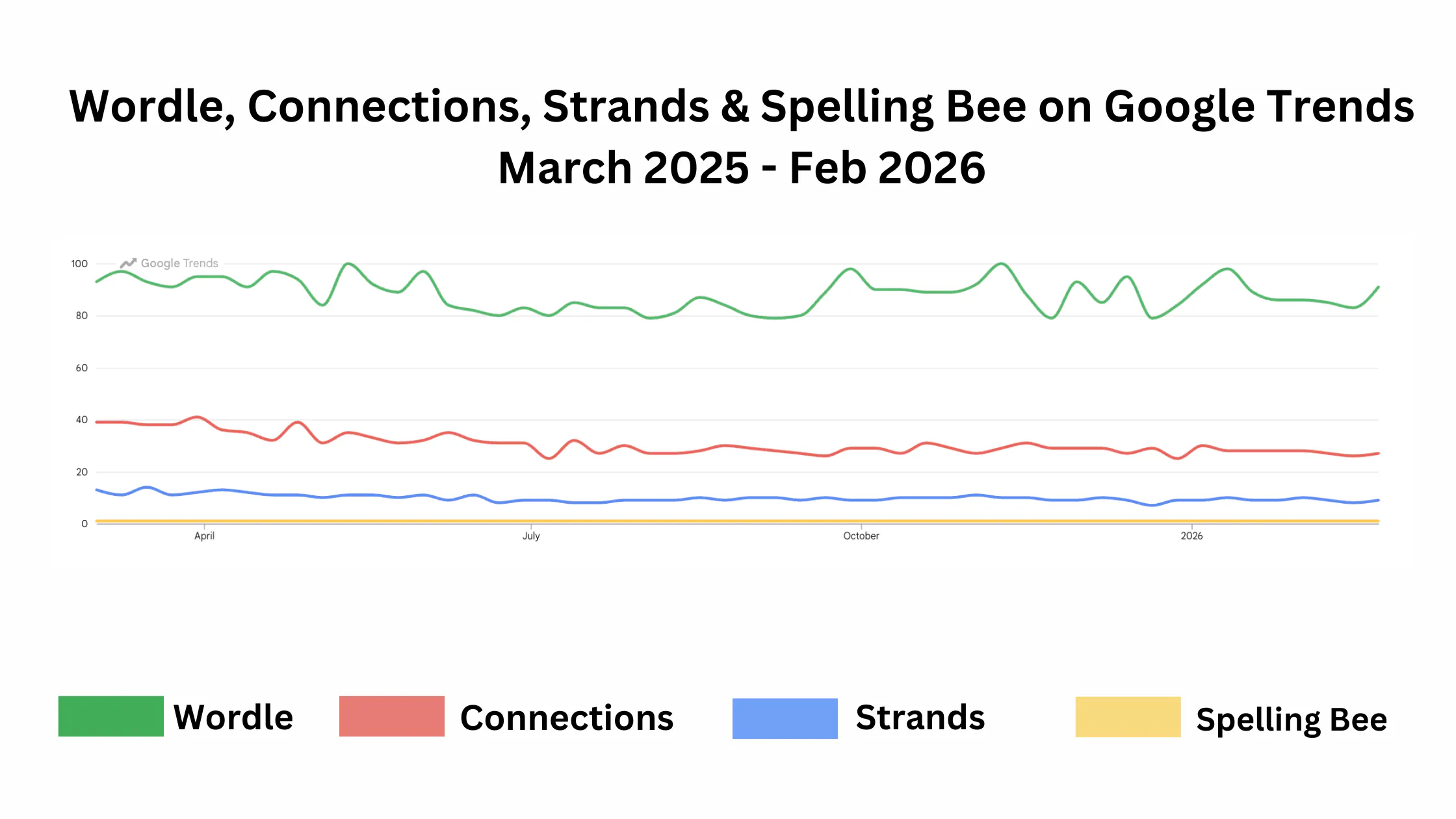
The picture hasn’t fundamentally changed. Strands remains the third-largest title in the NYT Games lineup, clearly behind Wordle and Connections, and still comfortably ahead of Spelling Bee.
What has shifted is momentum. Search interest for Strands is down roughly 25–30% compared to this time last year. That decline is milder than the drop we see for Connections (around 30%), but noticeably steeper than Wordle, which appears far more stable.
In short: Strands has held its position, but the initial surge has cooled.
What the Data Shows
Below, you’ll find our complete two-year database of Strands puzzles. It includes every daily grid from launch through Year Two, with date, theme, spangram, words, and category tag.
By default, the table is sorted in descending order by date (newest first). But you can: sort by any column, search for a specific word, theme, or category, or jump to a particular date.
Topics: A Clear Shift Toward Wordplay
Looking at the full two-year breakdown, the biggest structural change is thematic.
Year Two leans more heavily into Variety Pack (Other) and Language, Literature & Culture, both of which saw significant growth (77 → 97 and 73 → 88). At the same time, more concrete categories like Media, Entertainment & Leisure (72 → 48) and Food & Drinks (50 → 33) declined noticeably.
Many of the puzzles in Language, Literature & Culture revolve around synonym-based wordplay. The spangram often acts as a conceptual umbrella, while the theme words are near-synonyms, sometimes using less common or secondary meanings.
For example:
- IT'S A TRAP → DECEPTION, DECOY, LURE, PLOY, RUSE, STRATAGEM, TRICK
- LIKE A BOSS → ASSERTIVE, ASSURED, BOLD, CONFIDENT, COOL, SECURE
- A LITTLE OFF → ASKEW, ASLANT, CROOKED, LOPSIDED, TILTED, UNEVEN
These grids reward nuance. They’re less about spotting obvious categories and more about recognizing shades of meaning.
We also see growth in Education & Science (18 → 24) and Sports & Fitness (14 → 19), with the sports bump particularly noticeable during the Winter Olympics period, when timely themes appeared more often.
Repeated Words and Spangrams: Variety Still Wins
One concern with any daily puzzle is repetition. After 700+ grids, does it start recycling ideas?
So far, not really.
Across the entire second year of Strands, only two spangrams appeared twice: CROSSWORD and BASKETBALL. Every other spangram was a unique entry. That’s a strong signal that the editorial team continues to prioritize fresh central themes rather than revisiting past anchors.
When it comes to individual theme words, repetition exists, but it’s limited. The most repeated words were:
- STAR (5)
- MUSIC (5)
- CHERRY, WINGS, BLUE (4 each)
A longer list of words appeared three times: MATCH, HOME, BOOK, PENGUIN, JEWELRY, QUIET, and GOLDEN.
Explore the interactive word cloud to see how these repeated words are distributed.
In short: despite a few familiar faces, Strands continues to cast a wide lexical net.
Nine Puzzles That Stood Out
Beyond the trends and category shifts, some grids simply demanded attention. A few were unusually difficult. Others were structurally clever. One was just pure thematic charm.
Here are eight of the toughest puzzles from Year Two of Strands, in chronological order, plus one Valentine’s special that deserves its own spotlight.
Puzzle #379 (March 17, 2025 )– Sound Switching (SPOONERISMS)
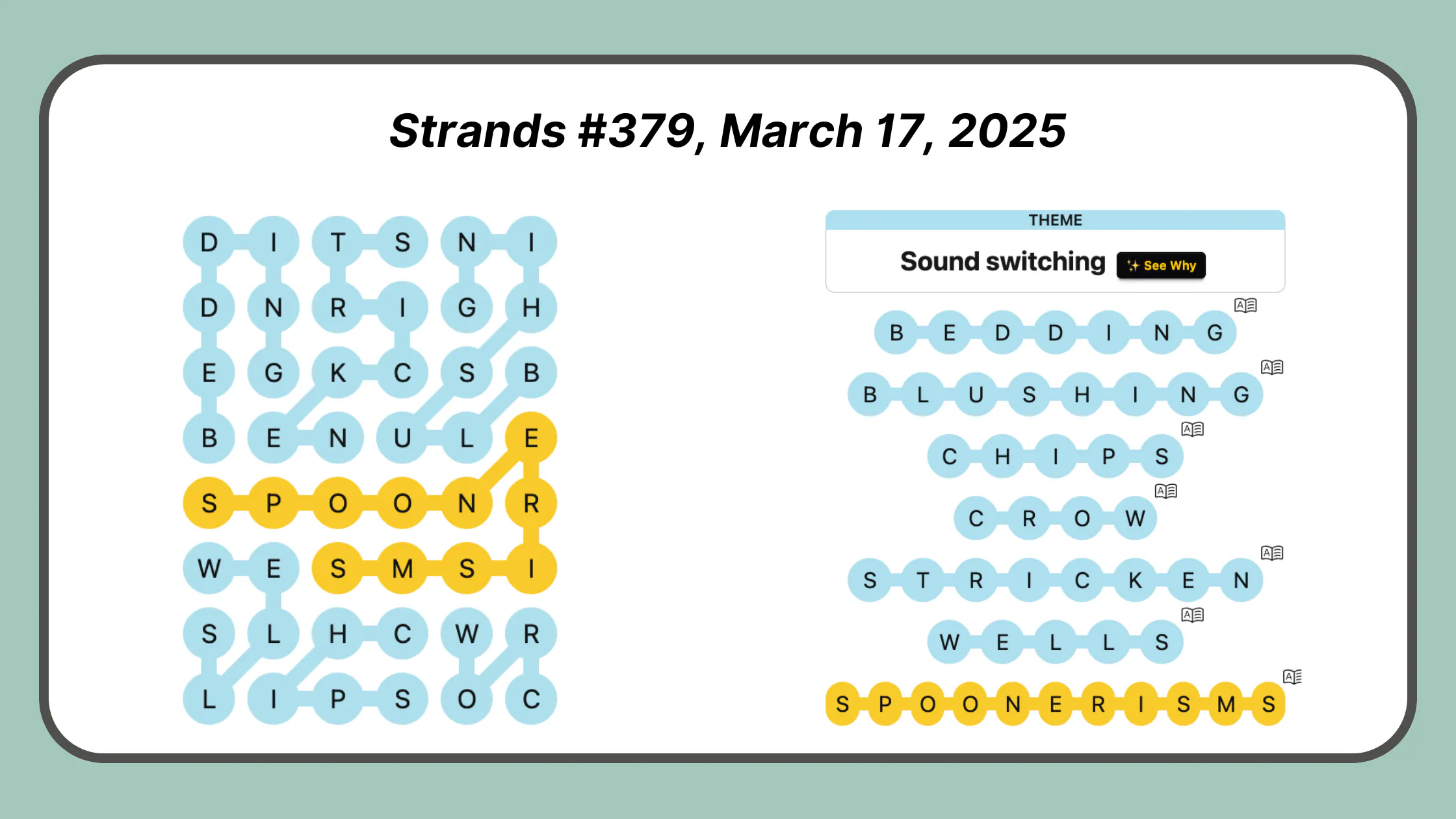
This was one of the trickiest language grids of the year. The theme words — BEDDING, BLUSHING, CHIPS, CROW, STRICKEN, WELLS — only made sense once the spangram SPOONERISMS fell into place. A spoonerism, for anyone who hasn’t thought about them since school, is a playful swap of initial sounds between words (think “fighting a liar” instead of “lighting a fire”). This puzzle depended on those sound reversals rather than clear semantic links, pushing solvers to think phonetically instead of categorically.
Puzzle #400 (April 7, 2025) – Half-and-half (HYBRIDCREATURE)
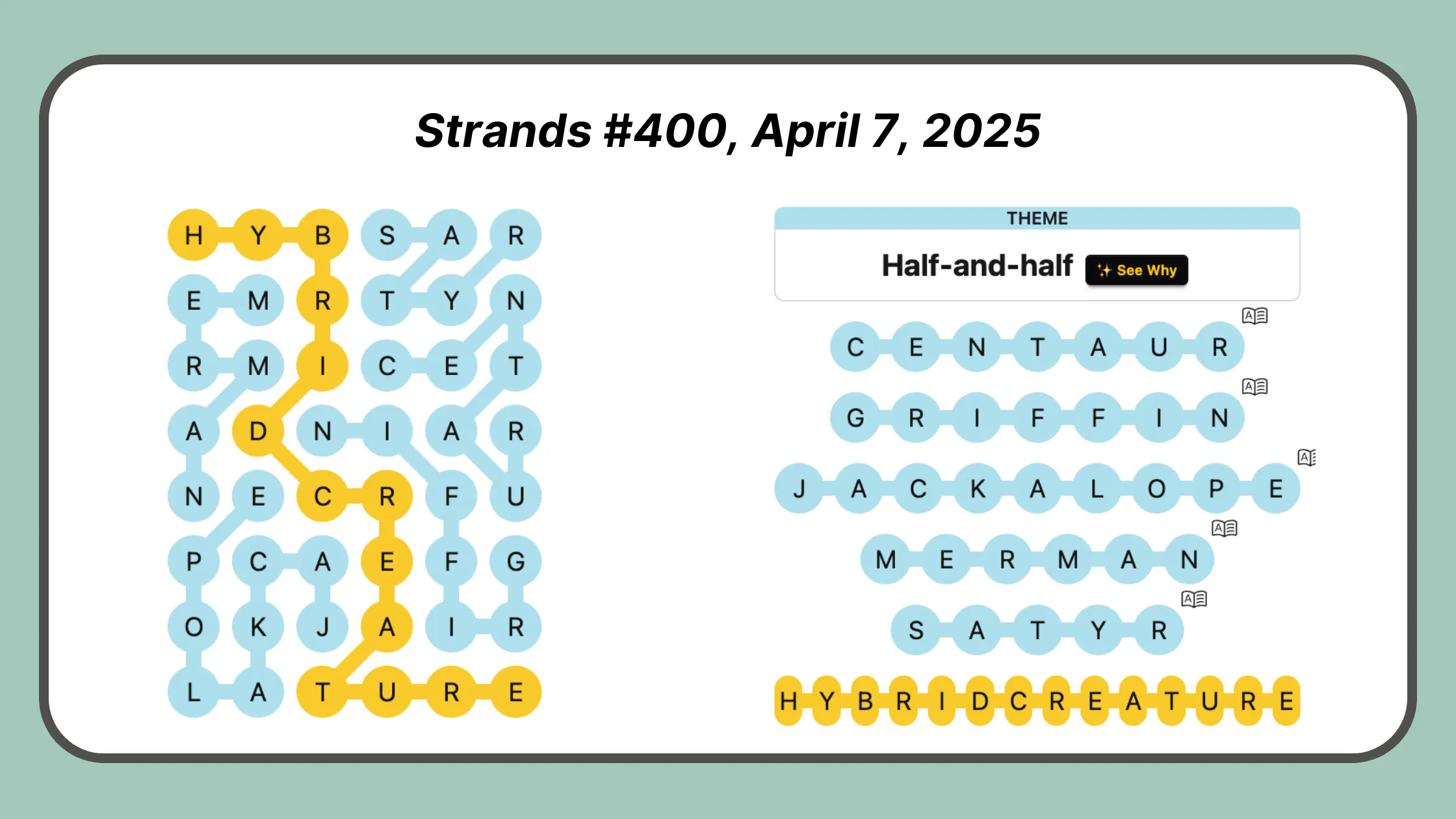
CENTAUR, GRIFFIN, JACKALOPE, MERMAN, SATYR — once HYBRIDCREATURE emerged as the spangram, the set felt clean and elegant. But until that reveal, the grid resisted simple categorization. Mythical taxonomy isn’t a daily mental category for most solvers, which made this one deceptively tough and satisfying.
Puzzle #422 (April, 29, 2025) – I’ve Got You Covered (SHELLS)
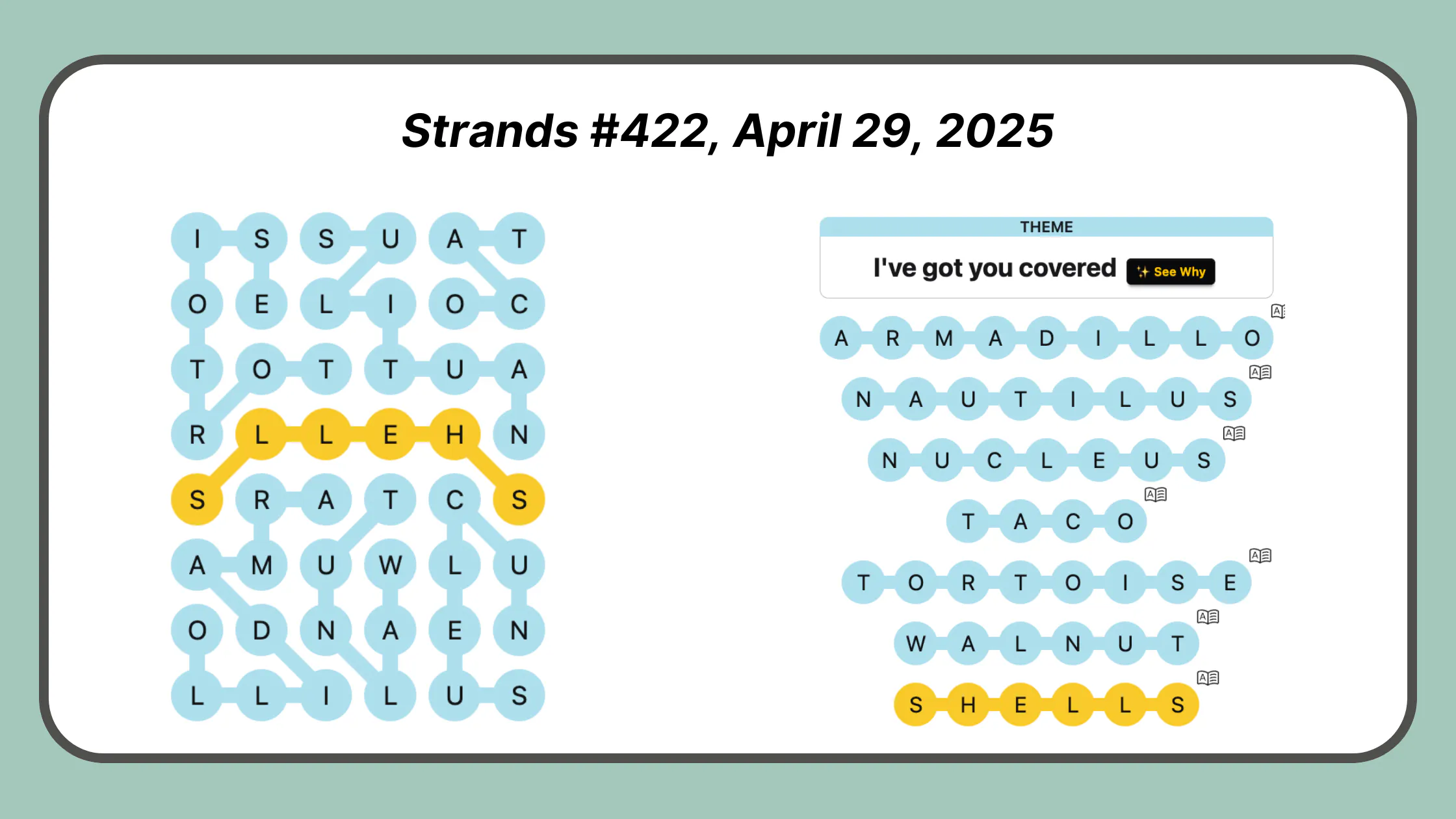
ARMADILLO, NAUTILUS, NUCLEUS, TACO, TORTOISE, WALNUT — at first glance, an unlikely mix. The connection only becomes clear once you think in terms of SHELLS. Some are literal animal shells, some are protective outer layers in biology, and others, like taco and walnut, are edible coverings. What makes this grid stand out is how naturally it blends science, food, and everyday objects under one clean idea.
Puzzle #534 (August 19,2025 ) – Dash It! (HYPHENATED)
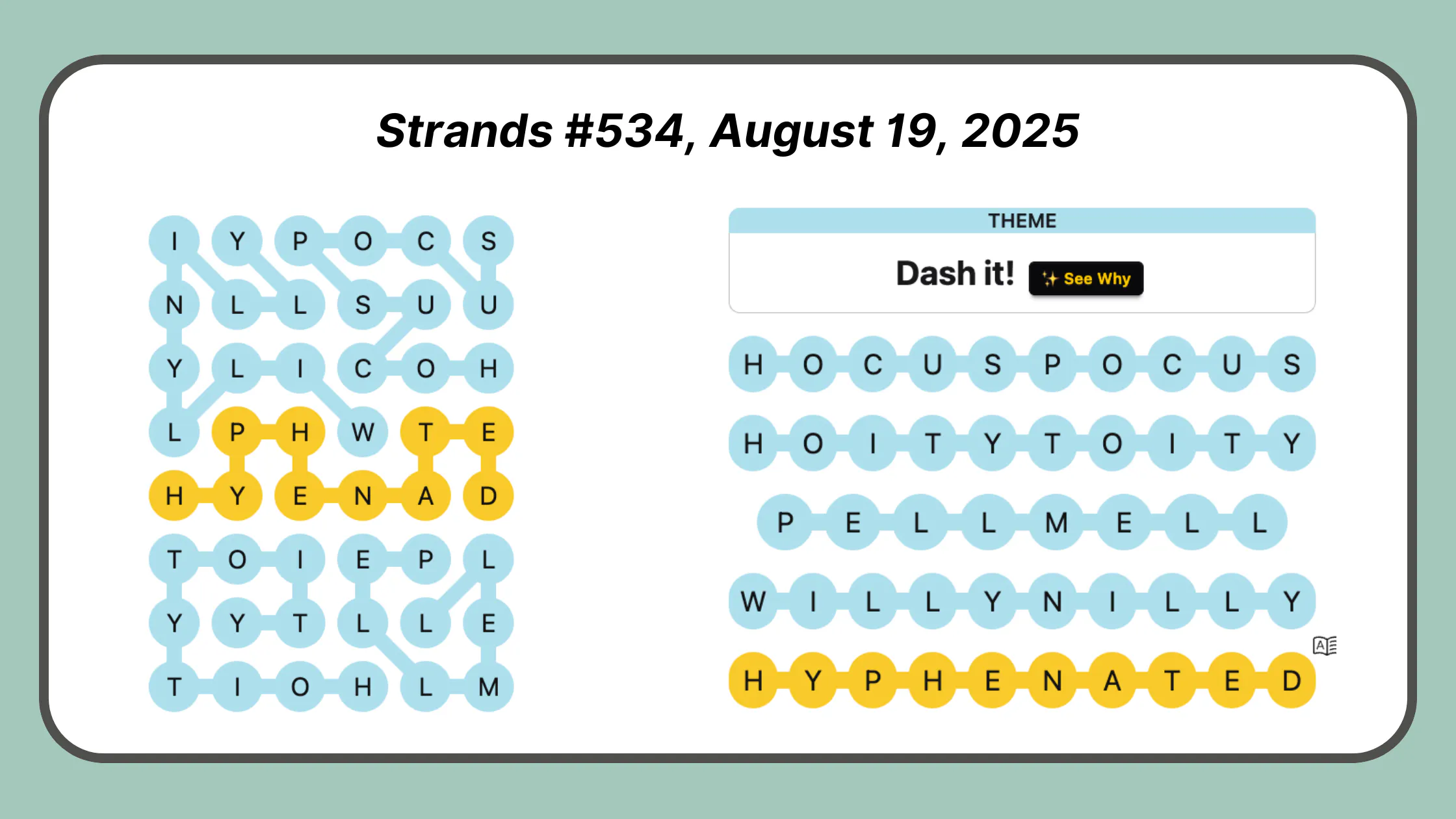
HOCUSPOCUS, HOITYTOITY, PELLMELL, WILLYNILLY — visually chaotic entries unified by one clean idea: HYPHENATED words (even when the hyphen isn’t always written). It felt playful but also linguistically sharp, another reminder that language-based grids tend to be the most mentally demanding.
Puzzle #549 (September 3, 2025) – That’s So Sweet! (SUGARY)
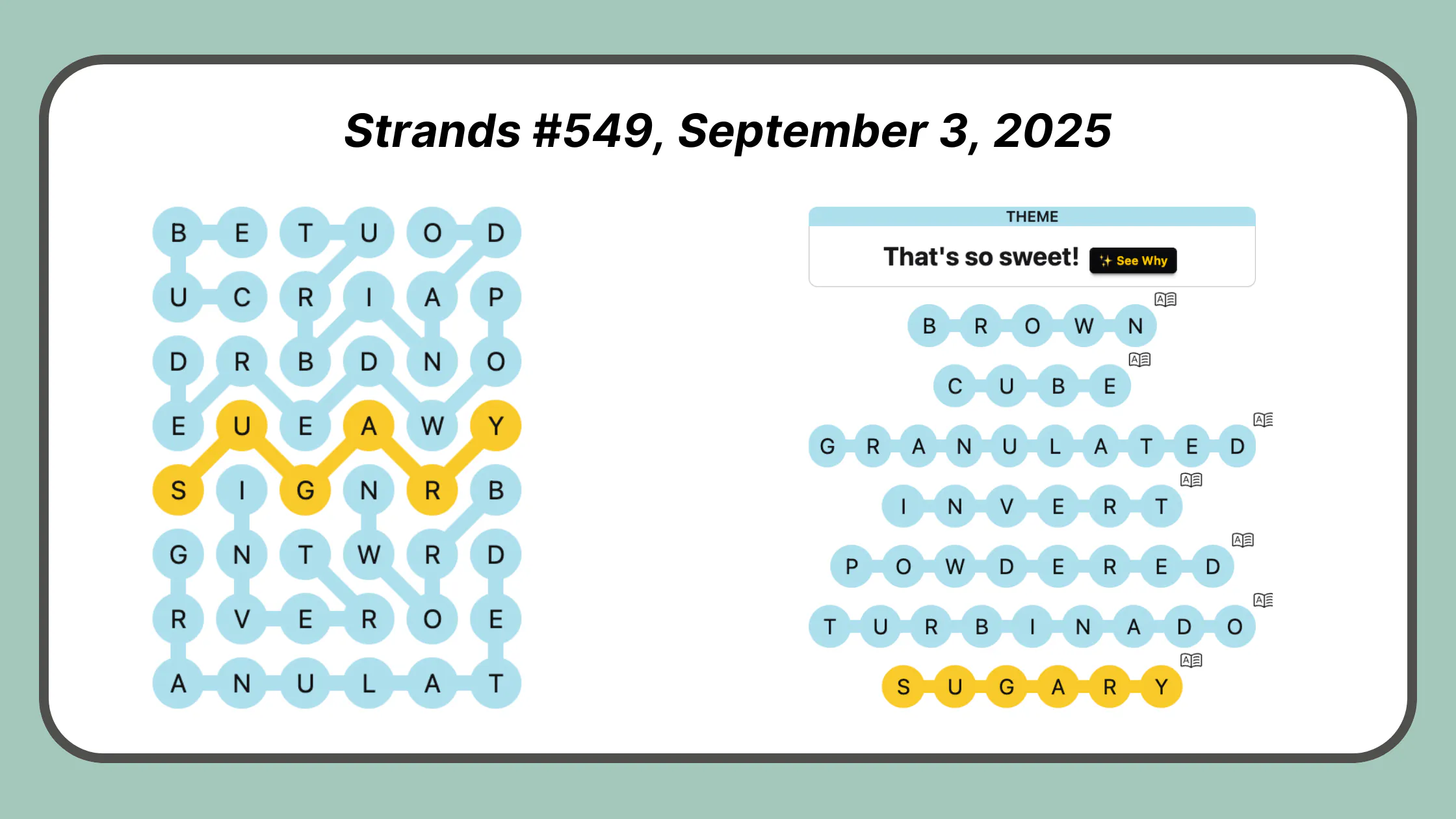
BROWN, CUBE, GRANULATED, INVERT, POWDERED, TURBINADO. On paper, a Food & Drinks puzzle, but the abstraction made it harder than expected. You had to think in forms and types of sugar, not desserts or flavors. A good example of how even traditional categories can be elevated through specificity.
Puzzle #614 (November 7, 2025) – Encuentra el ritmo (LATINMUSIC)
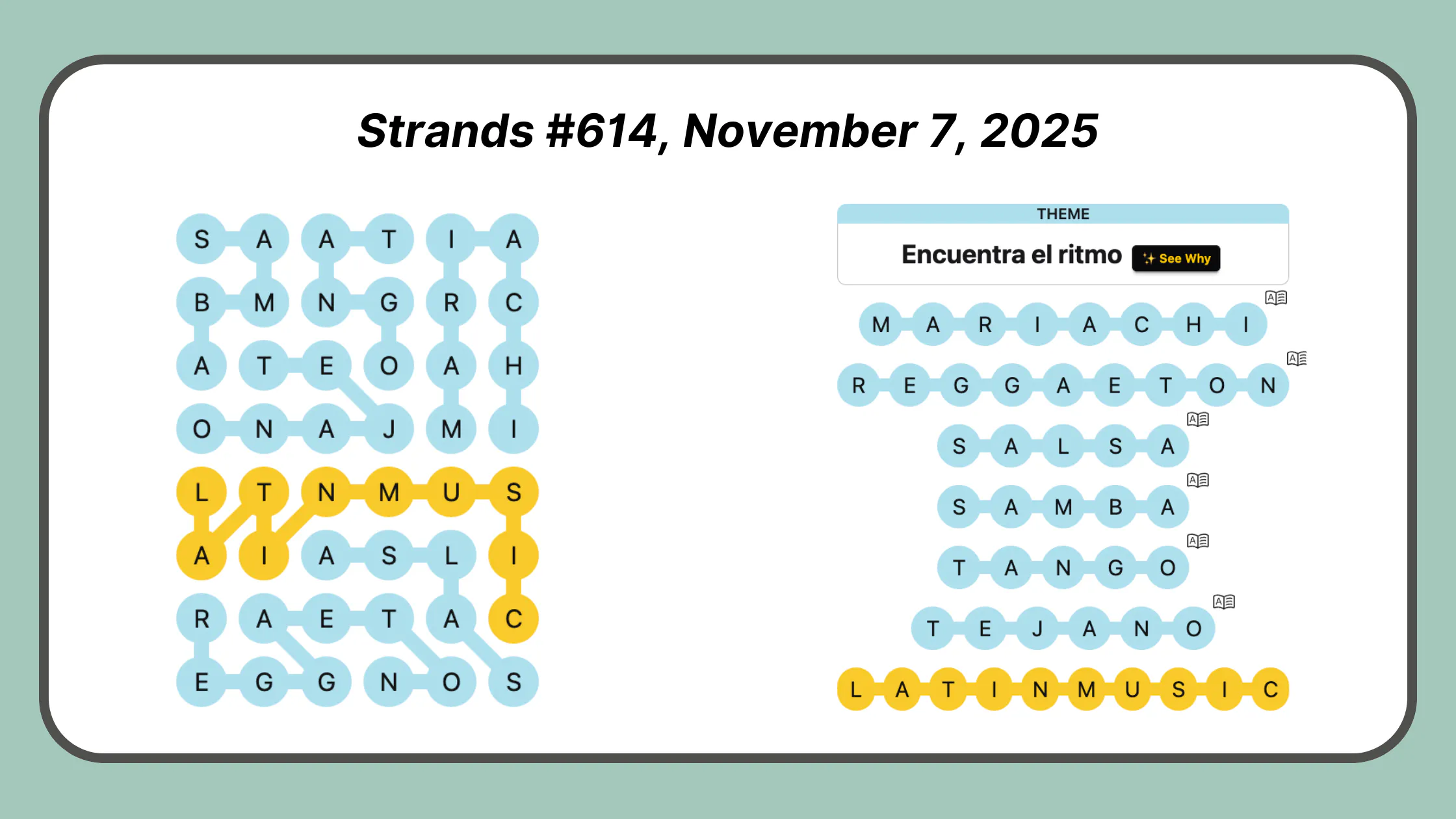
MARIACHI, REGGAETON, SALSA, SAMBA, TANGO, TEJANO — a lineup that spans countries, decades, and musical traditions across Latin America and beyond. From traditional Mexican mariachi to Argentine tango and Brazilian samba, the grid brought together genres that many solvers recognize by sound, even if they don’t group them together consciously. The unifying thread, LATINMUSIC, felt both clear and culturally grounded, making this puzzle less about trivia and more about rhythm, heritage, and shared musical roots.
Puzzle #667 (December 30, 2025) – 2025 Top Twenty (HITSONGS)
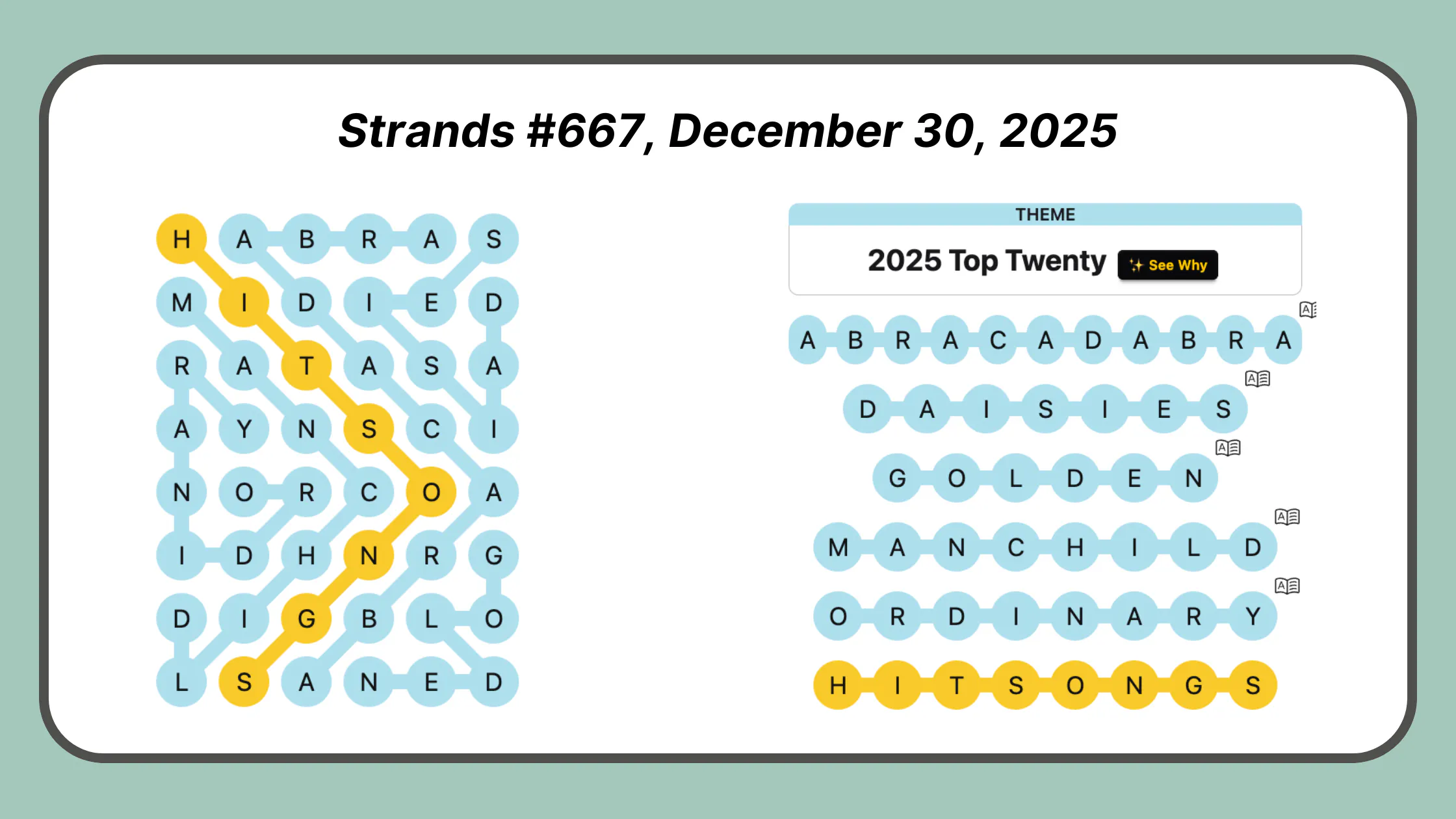
ABRACADABRA, DAISIES, GOLDEN, MANCHILD, ORDINARY — a snapshot of songs that defined 2025 across pop, indie, and mainstream charts. Instead of grouping by genre or artist, the puzzle pulled together standout track titles that had heavy radio play, streaming traction, or viral moments during the year. The spangram HITSONGS only clicked once you realized you were looking at a year-end playlist rather than a traditional word category.
Puzzle #702 (February 3, 2026) – On Key (SYMBOL)
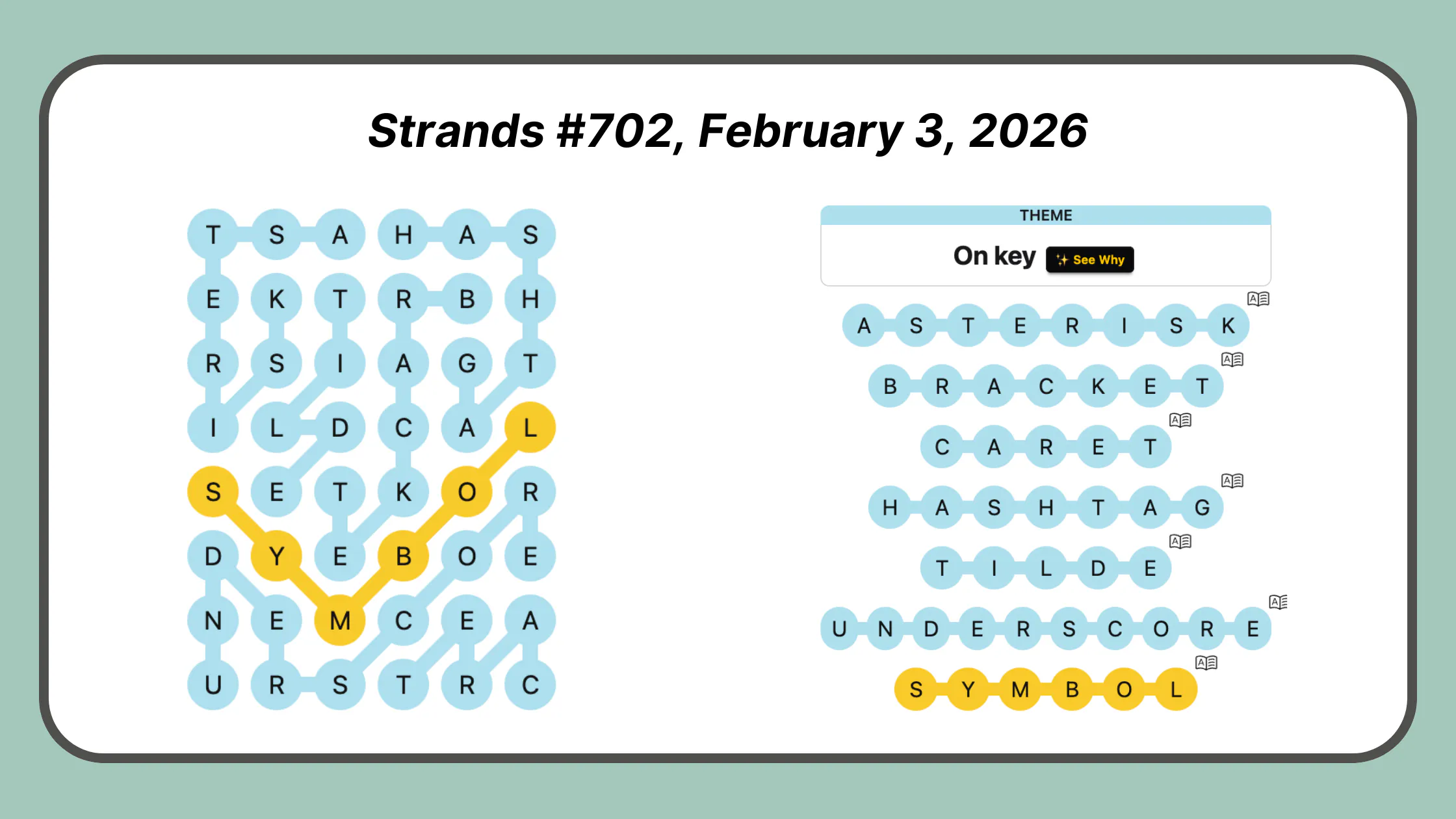
ASTERISK, BRACKET, CARET, HASHTAG, TILDE, UNDERSCORE. A deceptively simple grid built around keyboard symbols. It blurred the line between language and technology, landing in Education & Science but feeling deeply linguistic. Clean, modern, and slightly sneaky.
Puzzle #713 (February 14, 2026) – XOXOXO (HUGSANDKISSES)
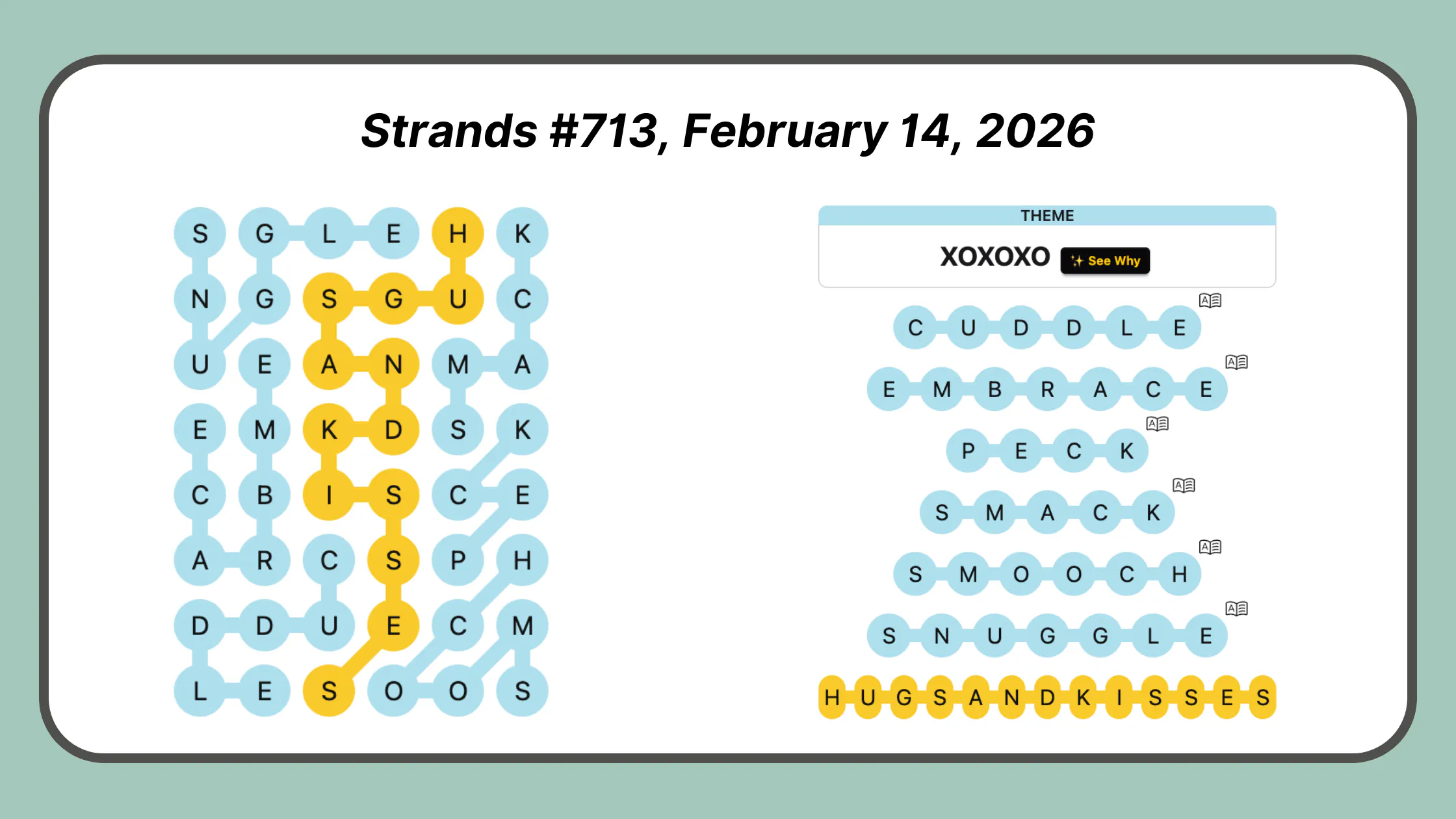
The Valentine’s Day 2026 puzzle deserves special mention for creativity alone. CUDDLE, EMBRACE, PECK, SMACK, SMOOCH, SNUGGLE came together under the spangram HUGSANDKISSES. It wasn’t the hardest grid of the year, but it was one of the most charming, showing how Strands can lean fully into theme without sacrificing cohesion.
Looking Ahead to Year Three
Two years in, Strands feels firmly established; it has an archive, The Sidekick, and increases wordplay.
What’s next?
One natural addition would be a bot, similar to what Wordle and Connections offer. A Strands bot could analyze, solve paths, hint usage, or even completion speed. As Year Three begins, the question isn’t whether Strands belongs in the NYT Games lineup. It’s how far it’s willing to experiment.
What was your favorite puzzle this year? And what would you like to see next? Let us know in the comments.