
 NY Times Mini
 NY Times Crossword
 NY Times Midi
 NY Times Wordle
 NY Times Connections
 NY Times Connections Sports Edition
 NY Times Strands
 NY Times Spelling Bee
 NY Times Pips
 Word Salad
 Contexto
 Blossom
 Betweenle
 Conexo
 Bracket City
 Fluxis
 Stacks
 Atlantic Crossword
 LA Times Mini
 LA Times Crossword
 Word Hurdle
 Crosswordle
 NYT Crossplay Solver
 Anagram Solver
 Scrabble Word Finder
 Words With Friends Word Finder
 Atlantic Games
 LA Times
 Zorzzle
 Word of Fortune
 Browser Extension
Before it was an app, Scrabble was a Depression-era invention. Created in 1931, it became one of the most popular board games long before the internet, eventually landing under the Hasbro umbrella and cementing itself as the defining word game. Digital play didn’t really explode until Words with Friends launched in 2009, riding Facebook virality to become one of the most downloaded mobile games of the 2010s after its acquisition by Zynga. Now, with NYT Games steadily turning into one of the most influential players in casual gaming, the New York Times has taken its clearest swing yet at reinventing competitive, Scrabble-style play for a modern audience.
While the Times hasn’t said when development began, the game spent nearly a year in quiet testing in New Zealand, then Australia and Canada, before launching worldwide (but still in Beta) on January 21, 2026. Coincidence or not, its arrival followed a wave of high-profile hires from Zynga, including Zoe Bell, who teased the game on USA Today just before the new year. Crossplay lives in its own app, but the NYT Games DNA is unmistakable: the color palette borrows familiar hues from Wordle and Connections, while the blue tones nod unmistakably to the Crossword. It’s also the first true two-player game in the NYT Games lineup, designed to feel instantly familiar, yet distinctly its own thing.
Watch this short 3-minute video for a clear overview of the basic rules before diving into the full guide.
How NYT Crossplay Works
Before strategy comes mechanics. This guide breaks down the Crossplay board, tiles, dictionary, and core rules, with an emphasis on what actually matters once you start playing. If you’ve played Scrabble or Words With Friends, much of this will feel familiar, but a few key differences are worth paying attention to.
Players
Crossplay is designed as a two-player game, whether you want a friendly match or a competitive challenge. You can invite friends in multiple ways: by sharing a link, scanning a QR code, connecting through Facebook, or simply choosing from your NYT Games friends list.
If you prefer to jump straight into a game, the app can also match you with a random player, letting you start a match instantly. Not ready for human opponents? Crossplay includes a computer mode with three difficulty levels, so you can practice your strategy at your own pace.
Because the game is still in Beta and the player base is growing, some users have noted that finding human opponents can take time, and the AI can feel less challenging than expected. These early quirks are likely to improve as more players join, and for now, the computer offers a convenient way to get familiar with the mechanics before diving into competitive play.
Board
The Crossplay board has a familiar feel at first glance, but with a few twists that set it apart. At the center, you’ll find the Times logo, but unlike in Scrabble, it doesn’t double the score of the first word. Surrounding it are 56 premium squares: 20 double-letter (2L), 20 triple-letter (3L) squares, 8 double-word (2W), and 8 triple-word (3W) squares. These are arranged in diamond shapes, giving the board a layout closer to Words With Friends than Scrabble, though still uniquely its own.

This arrangement offers some interesting strategic possibilities. For example, reaching the margins of the board can let you hit both a triple-letter and a triple-word bonus in the same move, rewarding careful planning and tile placement. The central lines, both vertical and horizontal, are densely packed with premium squares, which favors players who can spot high-value placements early. If you’re familiar with Wordle, you might notice that starting with a five-letter word that includes a valuable central letter can give you a strong opening advantage — a clever nod to the Times’ other popular word games.
The color design of the premium squares also echoes NYT Games’ other hits. Double-letter squares are yellow, triple-letter squares are green, double-word squares are blue, and triple-word squares are purple — subtly reminiscent of Connections difficulty categories: yellow for the easiest, purple for the trickiest. These visual cues not only make the board easy to navigate but also give an intuitive sense of which plays are high-stakes.
Tiles
Crossplay uses 100 tiles, just like Scrabble and Words With Friends, but with a few important differences that affect strategy. Most noticeably, the game includes 3 blank tiles, giving players extra flexibility compared to the two blanks in Scrabble and WWF.
The distribution of letters also has minor tweaks: there’s one extra H and S, and one fewer I, N, and U. These small adjustments may subtly change your rack management, especially in high-level play.
Point values have been adjusted in a few key ways as well. G, J, and V are worth 2 points more than in Scrabble, which makes J as valuable as Q and Z. This extra value for V makes sense, as it’s a difficult letter with no two-letter words and the notorious “VV death combo.” As for G, the increase is less obvious (some players might argue that C would have deserved it more), but it adds a twist for experienced players who rely on familiar Scrabble scoring patterns.
A few other letters also have slightly higher point values compared to Scrabble: B, H, K, L, U, and W each score one point more. These modest changes may seem minor, but they can subtly shift the value of common plays and make certain tiles more strategic when planning for premium squares or bingos.
Here’s a full breakdown of tiles and their points in Crossplay:
| Tile | # Of Tiles | Point Values |
|---|---|---|
| blank | 3 | 0 |
| A | 9 | 1 |
| B | 2 | 4 |
| C | 2 | 3 |
| D | 4 | 2 |
| E | 12 | 1 |
| F | 2 | 4 |
| G | 3 | 4 |
| H | 3 | 3 |
| I | 8 | 1 |
| J | 1 | 10 |
| K | 1 | 6 |
| L | 4 | 2 |
| M | 2 | 3 |
| N | 5 | 1 |
| O | 8 | 1 |
| P | 2 | 3 |
| Q | 1 | 10 |
| R | 6 | 1 |
| S | 5 | 1 |
| T | 6 | 1 |
| U | 3 | 2 |
| V | 2 | 6 |
| W | 2 | 5 |
| X | 1 | 8 |
| Y | 2 | 4 |
| Z | 1 | 10 |
⬇️ Download this complete list of NYT Crossplay tiles, including their counts and scores.
Dictionary
Crossplay uses the NASPA Word List 2023, the official word list for Scrabble tournaments in the US and Canada. You can also check any word in the dictionary at any time, even before playing it, making it easy to plan moves or explore new words without interrupting a game.
Rules of Play
Starting the Game
Each player begins with 7 hidden letters. The first word must cover the central square, but unlike Scrabble, it does not double the score.
Turns
Players take turns forming words that connect to existing tiles on the board. Words can be placed horizontally or vertically, but not diagonally. All placed tiles should form one continuous word. When you play a tile, it is replaced from the finite tile bag. On your turn, you can also skip or exchange tiles instead of playing a word.
Scoring
Premium squares work as usual, doubling or tripling letters or words. Playing all 7 tiles from your rack in a single turn earns a Sweep bonus of 40 points, similar to a Scrabble Bingo. The central square does not double the first word, and leftover tiles at the end of the game do not subtract from your score.
Ending the Game
Once the tile bag is empty, both players get one final turn. After that, the game ends, and any remaining tiles in your rack are not counted against you.
Additional Rules
If you’re playing against another person, you can cancel a game before making your first move; after that, the option changes to resign, which counts as a loss. Cancelling a game does not count as a loss. When playing against the computer, you can cancel at any time, but note that these games aren’t saved across devices and don’t affect your stats.
⬇️ Download the NYT Crossplay guide.
Additional Features
Crossplay includes several social and convenience features, including in-game chat, multiple ways to invite friends (links, QR codes, Facebook, or NYT Games connections), and post-game summaries (CrossBot) for matches played against other people. These summaries aren’t available for games against the computer, which are designed mainly for practice.
NYT Crossplay Strategy & Tips
Most of the fundamentals that apply to Scrabble still matter in Crossplay. Smart rack management, careful board control, and strong word knowledge remain the foundation of good play. If you already think in those terms, you’re in great shape — and we’ve covered them in depth in a dedicated Scrabble strategy guide.
That said, Crossplay’s board layout and scoring tweaks create a few opportunities that don’t exist in classic Scrabble. Here are three Crossplay-specific strategies we’ve uncovered through play so far.
1. Rethink your starting word
Because the central square doesn’t double the first word, the opening strategy shifts noticeably. The payoff isn’t raw word length, it’s positioning. The central vertical and horizontal lines are packed with premium squares, so a five-letter (or longer) starting word can often hit a double-letter and double-word bonus in the same move, while still covering the center.
When possible, place your highest-value letter in the middle of the word, where it benefits from the 2L premium square.
Below is a list of strong opening words (provided rack permits them), which we found reviewing tricky Wordle-style vocabulary :
- PIQUE
- MAJOR
- RAJAH
- GAZER
- RAZOR
- DOZEN
- FAVOR
- FEVER
- DUVET
- WAVER
- ENVOY
Notably, these avoid relying on multiple 10-point letters, making them more realistic.
2. Stack triple-letter and triple-word bonuses late
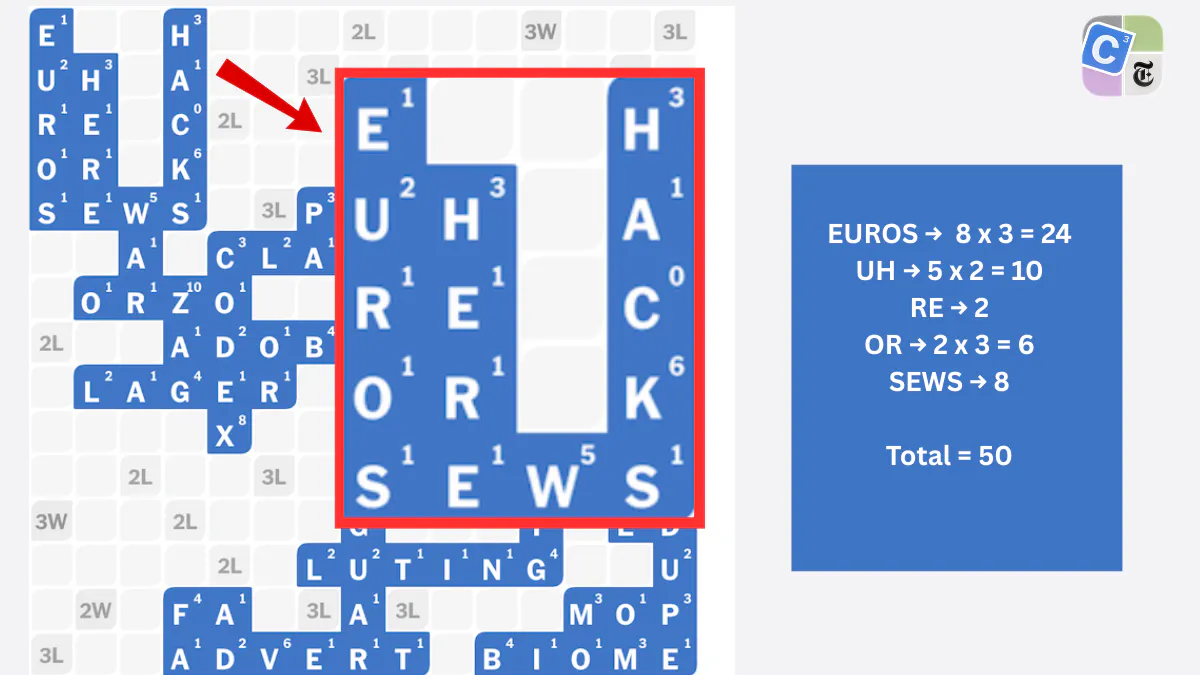
One of Crossplay’s biggest scoring quirks is the ability to combine triple-letter and triple-word squares in a single move, especially near the margins of the board. Late in the game, it’s often worth playing toward the edges and building multiple short words at once, even with low-value letters.
The image below features a move with a modest word like EUROS, building five connected words, activating multiple premium squares, and even multiplying existing tiles, resulting in 50 points without using a single high-value letter.
3. Respect the boosted V
With V scoring higher than in Scrabble, it’s worth treating it as a strategic asset rather than a burden. Medical and anatomical vocabulary is especially useful here, with playable options like UVULA, VALVE, VAGUS, and productive prefixes such as VASO-, VENO-, and VARI-. These words help turn a traditionally awkward letter into a reliable scorer.
Bonus tip: Don’t rush Qs and Xs at the end
Unlike Scrabble, leftover tiles aren’t deducted from your final score when the game ends. That means there’s no penalty for holding onto a Q or X while waiting for the right premium square. If the board allows it, patience is often rewarded — a late triple-word or triple-letter placement can easily outperform a rushed dump play.
Closing Thoughts
Crossplay is still new, and it shows — in the best and most unfinished ways. We’ll be keeping a close eye on updates, balance tweaks, and how the social side of the game evolves as the player base grows. If you’ve been playing, we’d love to hear what’s working, what isn’t, and what you hope comes next. The bigger question, though, is whether Crossplay can become the next landmark in word games, combining the competitive legacy of Scrabble and Words With Friends with the cultural reach of Wordle and the rest of NYT Games. If those worlds truly click, Crossplay might just be the next big thing.